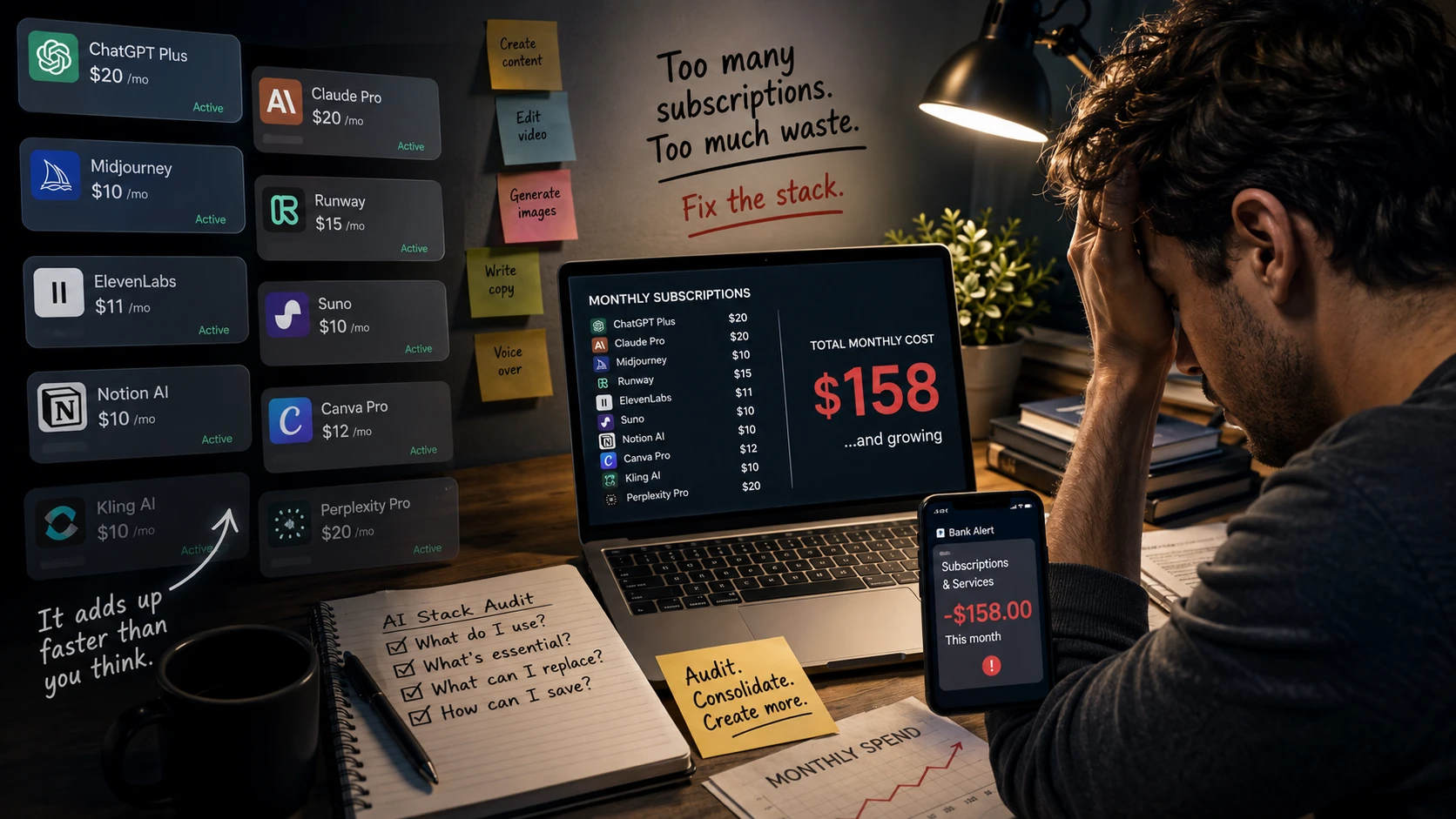
There's a pricing model quietly draining the budgets of every serious AI user, and almost nobody is talking about it directly.
It goes like this: a new AI tool launches. It's genuinely useful. You subscribe. A few months later, another tool launches that does something the first one can't. You subscribe to that too. Then another. Then another.
You're now paying for six AI subscriptions. Then eight. Then ten.
Each one felt like a reasonable $10–$20 decision at the time. Together, they've become a $150–$200 monthly line item - and you didn't notice it happen because no single subscription ever felt like a big commitment.
This is the AI subscription model. And it's broken.
How We Got Here
The current pricing landscape across AI tools isn't the result of deliberate industry coordination. It's the emergent outcome of dozens of companies independently making the same rational decision: charge a low monthly fee, make it easy to sign up, and make it slightly annoying to cancel.
Every individual company's decision makes sense from their perspective. OpenAI wants a direct billing relationship with you. Anthropic wants one. Midjourney wants one. So does Runway, ElevenLabs, Suno, and every other AI tool competing for wallet share and usage data.
The result, from the user's perspective, is subscription sprawl - a fragmented stack of tools with overlapping capabilities, separate interfaces, separate billing cycles, and a combined cost that nobody consciously agreed to pay.
The Three Failure Modes
The broken subscription model fails users in three distinct ways, and it's worth naming each one clearly.
Failure Mode 1: The Cost Is Opaque Until It Isn't
Individual subscriptions are cheap. That's the point - the friction to subscribe is kept deliberately low. But the friction to audit your full subscription stack is high. Most people don't have a clear number in their head for what they're paying across all AI tools.
When they sit down and actually add it up, the reaction is almost always the same: genuine surprise. The fragmentation of billing across multiple tools is, whether intentionally or not, a mechanism that obscures the true cost of building an AI stack.
Failure Mode 2: Workflow Fragmentation Is Expensive
The hidden cost of the current model isn't just money - it's time and cognitive overhead.
Every additional tool in your stack is another interface to maintain expertise in, another session to keep active, another set of usage limits to track, and another context switch in your production workflow. A creator using eight AI tools for content production isn't just paying for eight subscriptions - they're paying the productivity tax of operating across eight separate platforms.
This tax is real but invisible on any invoice. It shows up as slower production cycles, creative friction at tool boundaries, and the low-grade cognitive load of maintaining a complex technical stack.
Failure Mode 3: The Model Penalises Exploration
The per-tool subscription model creates a specific kind of risk aversion: users stop experimenting with new tools because adding another subscription feels like a commitment.
This is backwards. AI tools are evolving fast enough that the right stack today is probably not the right stack in six months. Users should be able to try new models, compare outputs across tools, and switch based on quality without feeling like each experiment is a new financial obligation.
The current model punishes exactly the behaviour - exploration and comparison - that produces the best outcomes for users.
Who Benefits From the Current Model (And Who Doesn't)
To be fair: the current subscription model works well for power users who use one or two specific tools intensively and don't need much else. If you're a professional Midjourney user generating hundreds of images per day, a direct high-tier subscription is probably the right structure.
But that's a minority use case.
The majority of AI tool users are creators, marketers, and entrepreneurs who need competent coverage across multiple content formats - text, image, video, audio - and don't need professional-tier access to any single tool. For this majority, the per-tool subscription model is a consistently bad deal.
What's Already Changing
The market has started to respond. Aggregator platforms that bundle access to multiple AI tools under a single subscription are gaining traction - and they make the economic logic of the fragmented model increasingly hard to defend.
Platforms like glown.ai are built on a simple premise: most users don't need a direct subscription to every AI tool they use. They need reliable access to the best tools in each category, under one login, at a consolidated price. The underlying models - Grok Image, Nano Banana, Kling, Suno, Seedance 2.0 - are the same. The interface and pricing structure are different.
This model works because the aggregator can negotiate access at scale and pass the savings to users, while users get a unified workflow and a single, predictable billing relationship.
It's not a new idea. It's the same logic that made Spotify better than buying individual albums, and Netflix better than subscribing to every studio's streaming service individually. Aggregation at the platform layer creates value for users when the underlying content or tools are fragmented.
What Comes Next
The current per-tool subscription model has a structural problem that will force it to evolve: as the number of viable AI tools in each category grows, the cost and complexity of maintaining a full stack through individual subscriptions becomes increasingly untenable for ordinary users.
There are a few likely directions:
Consolidation through aggregation. All-in-one platforms continue to grow, taking share from individual tool subscriptions by offering better value for the majority use case. Individual tools retain their power users on direct subscriptions but lose the casual and moderate users to aggregators.
Usage-based pricing. Some tools will move away from flat monthly subscriptions toward pay-per-use models that better match cost to actual usage. This addresses the "paying for tools you barely use" problem but introduces its own complexity around budgeting and cost prediction.
Platform integration. Major platforms (Adobe, Notion, Canva, etc.) will continue integrating AI capabilities directly, reducing the need for standalone AI subscriptions in categories where the incumbent platform can offer "good enough" AI functionality as part of an existing subscription.
Creator-specific bundles. Tools will increasingly offer curated bundles targeting specific user types - a creator bundle, a marketing bundle, a developer bundle - rather than requiring users to assemble their own stack from individual subscriptions.
The common thread across all of these directions: the current model of every tool independently charging every user a separate monthly subscription will give way to more consolidated, user-centric structures. The economics of fragmentation don't hold up as the market matures.
The User's Position Right Now
For anyone currently navigating the fragmented AI subscription landscape, the practical position is clear: audit your stack, identify the tools you actually use, and evaluate whether an aggregator platform covers your needs at a lower combined cost.
For most users doing this exercise honestly, the answer points toward consolidation.
The AI subscription model is broken. But the solutions exist - and they're available right now, not in some future version of the market.
AI trading platform AI in Business AI in Finance AI in Healthcare AI Automation AI Trading AI Office Tools AI Consolidation AI for Creators Content Creation AI Pricing Workflow Fragmentation AI Aggregators glown.ai Subscription Costs AI Tools AI Subscriptions